As Eddie Sheridan prepares to return to school to get a degree in nursing, he’s doing more than just taking the prerequisite classes: The 31-year-old resident of Gainesville, Florida, is also working to pay off his credit card debt.
“I’m trying to get everything in order now, to pay off as much debt as possible,” he says, before he takes on new student loans.
With interest rates rising, credit card debt is getting more expensive, making now a good time to pay it off even if you don’t have student loans on the horizon.
That’s not an easy feat in the middle of the holiday spending season, but it is possible. Here are tips from debt experts on just how to do it.
First, set your budget
Marcus Garrett, co-host of the “Paychecks and Balances” podcast, says he built up credit card debt in college and finally made a budget at age 27. That spending plan allowed him to get serious about paying it off.
“I just needed to be more responsible,” says Garrett, who is now 36 and lives in Austin, Texas.
Eric Tyson, author of “Personal Finance for Dummies,” recommends starting by looking closely at monthly spending. “A lot of people don’t have a good handle on that,” he says. Once you see how much money is going toward expenses like dining out or buying clothes, it can be easier to trim, he says.
Then, negotiate your way to lower payments
One way to lower your monthly credit card payments, Sheridan says, is to try to negotiate with your card issuer to lower the interest rate on your card. He says that move has been successful for him.
“You just have to be assertive and polite,” he says. If he doesn’t get the answer he wants from his card issuer, then he doesn’t hesitate to take his business elsewhere.
“Customers do have power; the banking industry is very competitive,” he adds.
If that doesn’t work, shop for a new credit card
Sheridan also uses balance transfer cards to pay off his debt. He moves his existing balances to cards with an introductory 0% APR period, which typically lasts 12 to 18 months, and then tries to pay off the balance before that rate expires.
These types of offers typically require good to excellent credit.
Check the long-term interest rate
Kristin Wong, author of “Get Money: Live the Life You Want, Not Just the Life You Can Afford,” says that while balance transfer cards can work out well as long as you pay off the balance before the introductory offer expires and make every minimum payment each month, it can create even more debt if you still have a balance after that period.
“If you don’t pay off the balance within a certain time frame, you can be hit with a crazy high interest rate, which will defeat the purpose of the transfer or even end up costing you more,” she warns.
Thankfully, there are ways to find out who owns a mobile phone number, some methods are easy, some not so much. To try any of these methods, all you have to do is go on the internet.In this article, I’ll share with you eight possible ways to search who is calling your phone number.
Did you realize that you can look for individual on Facebook by entering a phone number? By entering a phone number on the Facebook search bar, you may be able to find the profile of the person to which the number belongs to.
To do this, simply login to your Facebook account and enter in the phone number in question in Facebook search bar. If the phone number is associated with an account, that account will pull up. Additionally, if the phone number was ever shared in a Facebook post, that post will pop up as well too.
Unfortunately, most people have changed their privacy settings so that people can’t find them on Facebook that way or they don’t add their number to their profile at all. Some people don’t want other people to find a cell phone number on their profile, and that’s why they keep this information private.
Additionally, it is not guaranteed that you will get the most up to date, accurate data and that person may not have that number anymore. According to TrapCall, a phone number has to be deactivated for 90 days for another person to be able to use it, and phone companies are more than willing to use a phone number as soon as it passes that 90 day mark.
2. Answering The Phone or Calling Back
Regardless of what the circumstance is, it’s never a good idea to answer an unknown phone number or call back on your cell phone. If your phone call is from a scammer or stalker, picking up the phone may put you in a dangerous situation. If it’s important, they will leave a voicemail.Here are a few reasons that you should never pick up the phone when you are not sure whose number is calling:
It could be a scammer who has perfected the art of being a con artist.
It may be a telemarketer, and if you pick up they know your number is an active one and they will put it on their list.
It could be an ex or someone who is fixated on you and wants to hear your voice.
It could be a predator seeking a victim to prey on.
It could be from a one-ring phone scam.
It’s safe to say that it’s not the best idea to answer an unknown call because you never know who is on the other end.
3. Using A Reverse Phone Search To Find Cell Phone Numbers
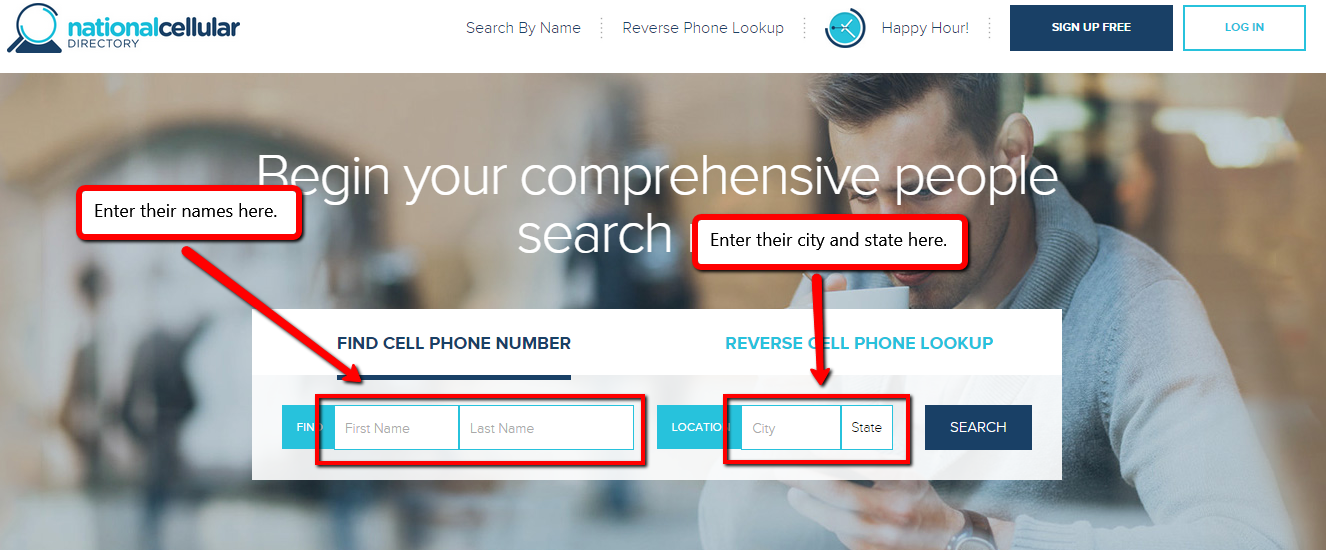
Reverse phone search websites like National Cellular Directory are perfect for anyone because they specialize in people searching and finding cell phones numbers.
They offer 100% confidentiality when searching for a number and are far more convenient than playing guessing games with social media and search engines.
Doing a reverse phone search Is the most comfortable, most reliable and safest way to find out who is calling you.
What is a reverse phone search?
It’s a search where you enter in a phone number and National Cellular Directory’s database of billions of records will be scanned in moments. If we have information on the owner of that phone number, that information will be shown in the results.
Use The Toolbox Below To Perform A Reverse Phone Lookup Now! Reverse Phone Lookup
Another amazing benefit to creating a free membership with National Cellular Directory is that they have a Happy Hour every day where you can do two premium cell phone searches for free of charge! That means that you can find the most recent and accurate information about a phone number at no cost to you!
Follow These steps to get a free people search:
Create an account on National Cellular Director.
Follow National Cellular Directory on Facebook or Twitter. They tweet (and post on FB) the next Happy Hour start and end time.
Run their free people search and get the answer you are looking for!
It’s that simple! And the best part is, you get to do it every day if you need to! Doing a reverse phone search will get you the name, address, city, state, other phone numbers that belong to an owner if available.
4. How to Use Google to Find Cell Phone Numbers
Google used to have a phonebook service, but it was taken down when people started wanting their information removed from the service. Therefore, Google isn’t the best choice for someone to look up another person’s number.
Even on the off-chance that Google has any information in regards to who has been calling you, it may not be reliable or up to date. I know it’s simple to lookup a phone number on Google. It’s certainly worth a try. However, don’t get your hopes up as it is more than likely that you won’t find any current owner information on the phone number n question.
5. Research The Area Code
The area code listed on the phone number that keeps calling you may give you more insight into what kind of call it is than you realize. Foreign area codes are most of the time scammers.
Toll-Free numbers like 800 or 844 are usually telemarketers. Always beware of toll-free numbers and calls coming from outside of the US. Also look at this list from Forbes to see the some international area codes that are unsafe.
Additionally, the area code will give insight into where someone lives. In the illustration below, you can see that 5.7 million cell phone numbers start with 917. If you look up that area code from a cell phone number, you will discover that the caller lives in New York City.
6. 800notes.com
This phone number database is built by its users. People share information on a call they receive. If other people have had a call from the number that is contacting you, they can report it on the website for you to view at your leisure.
This method will only work if the number is calling other people and at least one other person has reported the number to you.
Additionally, even if they report the number they might not have any more information than you already have on the number.
7. Pipl
Pipl does have a free phone search, but it doesn’t seem to have the most accurate, up-to-date data.
When entering my cell phone number, I was given old information about myself including my maiden name, (but not my married name) an old landline number (which was disconnected a few years back), a former address, and they had my age wrong by 16 years.
8. Whitepages
Whitepages claims to be free, but after it compiled my report, the website asked me to pay for the information is found on the number I provided.
It did not offer me the name, or even address of the person who owned the number. Something it did offer me for free was that it was a low-risk number and the general area of the owner’s location. I knew at that point that the number I searched was low risk, so that information was valuable. However, any other information that I wanted I had to pay for.
I recently invited my team to take part in a straw poll. I wanted to understand what frustrated them; what got in the way and stopped them doing a great job.
I learned the reasons why my team is frustrated. They told me their four top gripes. This is what I heard.
1. Inadequate Processes
The team is frustrated with rules. Rules and processes that make no sense.
Digging a little deeper I realised this wasn’t about rules per se but how the rule book stops progress.
And, here is the rub: the business has to make big savings. It needs to do things completely different.
We are distracted by trivial bureaucratic policy and procedure.
Progress is not made because employees fear breaking the rules. So, the team is frustrated because it cannot innovate. Its attention is diverted from what is really important. When management creates barriers to progress it cannot expect outstanding results.
2. Limited Opportunity to Develop Skills
My team loves to learn. And they are damned good at what they do. Even so, the team is frustrated by the limited opportunity to develop new skills.
Skills needed to propel the organisation forward. The team is frustrated because they are not in control of their development.
Bureaucracy is not attentive to people’s feelings or potential. Bureaucracy determines what people should do.
Bureaucracy focuses on weakness not strength.
The team is frustrated because it cannot be exceptional at what it does. The organisation won’t invest in the right skills. It fails to develop exceptional people. When management creates barriers to progress it cannot expect outstanding results.
3. A Lack of Decisiveness or Commitment
When progress is made opportunity beckons. But bureaucracy always misses opportunity.
Bureaucracy is indecisive and lacks commitment.
The team is frustrated because their work is sometimes undone by indecision. The business undervalues their very hard work when it doesn’t take advantage of the new found opportunity. When management creates barriers to progress it cannot expect outstanding results.
4. Failing to Take Responsibility
The team is frustrated when progress isn’t made. When their work is done, others use it to produce results. Or, choose not to do anything.